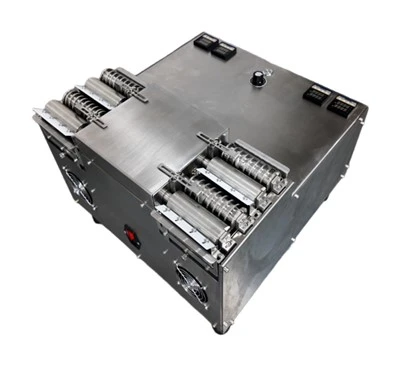
Arabic Gum vs Distillate for Pre-Roll Coating: Which Adhesive?
Every kief-dusted or infused pre-roll starts with the same hidden decision: what goes in the primer? For most lines running a preroll glue coater, the choice is between food-grade arabic gum pre roll primer and pre roll distillate. One is the quiet workhorse; the other is the potency play. This guide compares them on cost, behavior, and how to choose - and explains why temperature control sits at the center of both, no matter which you pick.
Arabic Gum: The Default Primer
Food-grade gum arabic is the standard adhesive for external infusion, and for good reason:
Food-grade and safe. It is a recognized food hydrocolloid, odorless and colorless.
Water-soluble. Easy to mix and clean up with warm water between runs.
Low cost. Pennies per unit, which protects margin on high-volume SKUs.
Enough tack. It holds kief and hash dust reliably without adding any cannabinoids of its own.
For the majority of arabic gum pre roll applications - kief dusting, hash rolling, appearance-led SKUs - gum arabic is all you need. It delivers the tack the pre roll kief coater depends on, with none of the potency cost. Sourced as a stable powder and reconstituted to spec, it is also the easiest adhesive to store and handle at scale.
Cannabis Distillate: The Potency Play
When the goal is to add strength and a glossy, resinous look, operators switch the adhesive layer itself to pre roll distillate (or another viscous concentrate). Here the "glue" is also the infusion:
Adds potency directly. Cannabinoids ride in the coat, lifting the joint's strength.
Glossy appearance. Distillate gives a wet, premium sheen that gum arabic cannot.
Higher cost and odor. You pay for the concentrate and manage its smell and handling.
Tighter process window. Distillate only flows in a narrow temperature band, so it demands precise control on the preroll glue coater.
Distillate is the right call when the coat itself is part of the product story, not just the glue. Used well, it turns a standard infused pre-roll into a visibly premium, higher-potency SKU.
Viscosity & Temperature Control
The thread connecting both adhesives is viscosity, and viscosity is governed by temperature. Gum arabic thickens as it cools and thins as it warms; distillate is far more sensitive, softening toward pourable only within roughly 35–55 °C. If the reservoir runs cold, the film is lumpy and under-applied; too hot, and the adhesive weeps and drips, pooling at the tip.
This is why a preroll glue coater with stable temperature control is non-negotiable - especially for distillate. The machine is effectively a viscosity-management system: hold the adhesive in its working window and coat weight stays consistent batch after batch. Skimp on temperature control and even perfect gum arabic will apply unevenly, while distillate becomes unmanageable.
How to Choose
|
Factor |
Arabic gum |
Distillate |
|
Cost per unit |
Very low |
High |
|
Potency added |
None |
Yes |
|
Appearance |
Matte, invisible |
Glossy, resinous |
|
Temp sensitivity |
Low–moderate |
High |
|
Cleanup |
Warm water |
Solvent-compatible |
|
Best for |
Kief/hash dusting, volume |
Potency + premium look |
Choose arabic gum when you want reliable tack at low cost and the infusion is purely visual (kief dusting). Choose distillate when the coat must carry potency and a glossy finish, and you can support the tighter process control it needs. Many brands run both on the same preroll glue coater by swapping the reservoir - which makes a temperature-controlled, easy-clean unit the most flexible buy.
A Simple Decision Workflow
Is the coat just for sticking kief? → Gum arabic.
Does the SKU need extra potency or a glossy look? → Distillate.
Are you running both? → Spec a preroll glue coater with tight temperature control and fast clean between adhesives.
Validate with a trial on your real flower and cones before locking the formula.
Storage & Handling Notes
Adhesive quality off the machine drives coat quality on it. Gum arabic solution should be made fresh or refrigerated and used within its stable window to avoid fermentation or viscosity drift; distillate should be kept in sealed, light-protected containers and tempered to working temperature before the reservoir is filled. Treat the adhesive as a formulation input, not a commodity supply, and coat weight stays where you set it. Between adhesive changes, flush the reservoir and wipe the roller and doctor blade so residue from one formula never crosses into the next SKU - a small habit that protects both consistency and compliance.
FAQ
What glue for pre rolls is safest? Food-grade gum arabic is the safest default - recognized for food contact, odorless, and easy to clean. Distillate is safe when handled and temperature-controlled correctly.
Arabic gum vs distillate pre roll - can I mix them? Not in one reservoir, but you can run gum arabic as primer and add a distillate top note separately, depending on your process and local rules. Keep them as distinct stages.
Does gum arabic affect the taste? Properly applied, it is essentially tasteless and odorless, so it does not compete with the flower or terpenes.
Can a single preroll glue coater handle both? Yes - provided it has adequate temperature control and is easy to clean between adhesives. Confirm material compatibility with the [ADD URL: Preroll Glue Coater product page] Preroll Glue Coater product page.
Which adhesive is better for high volume? Gum arabic, almost always: lowest cost, simplest handling, and no potency accounting. Reserve distillate for SKUs where the added potency and sheen justify the cost.
Related & Next Steps
Check material compatibility on the [Preroll Glue Coater product ] , see the glue-first method in [How to Coat Pre-Rolls with Kief], or return to the [ Preroll Glue Coater ] Preroll Glue Coater main guide for the full materials breakdown. Specifying a line? [ contact us] Request a quote.